
That phrase turned into a prophetic explanation of the nation’s midterm elections this past Tuesday. Trump used it constantly in his campaign rallies, thinking it would motivate his base to turn out and help Republican candidates. The problem is that when a president’s job approval rating is one of the lowest in recent history, that might not be the best message for voters. Based on the results, voters connected the two points and launched a blue tsunami that shifted the balance of power in Congress. So, what impact did that wave have on the races across the country?
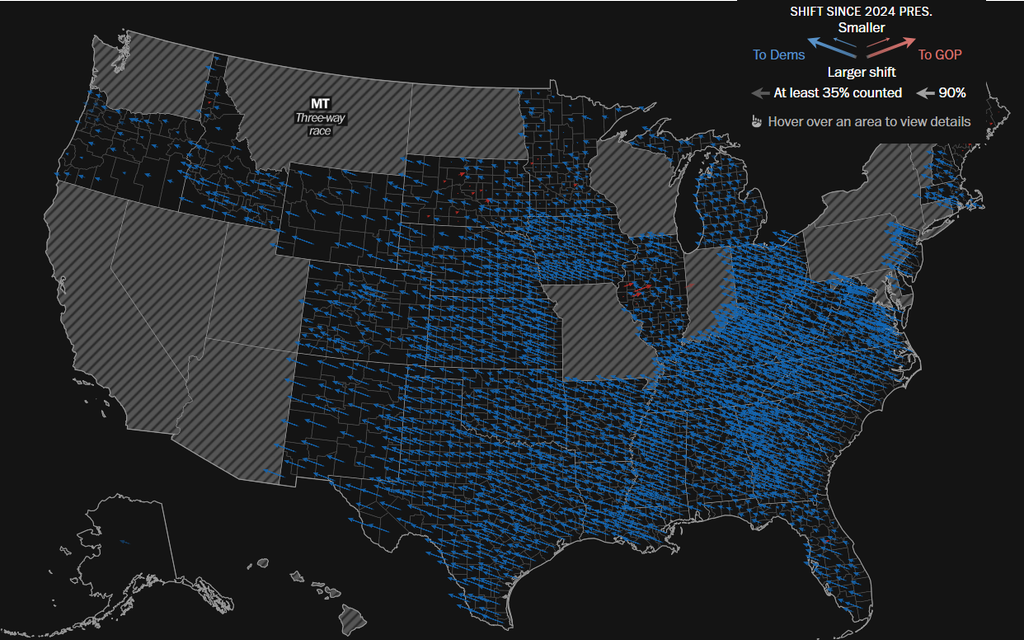
The biggest change from 2024 to 2026 was the overall trend toward Democrats nationwide. In fact, aside from a few counties in Indiana, Maine, and South Dakota, every county in the nation trended toward Democrats, reflecting a widespread rejection of Trump. While he may have claimed not to be on the ballot, in many ways, he was. Voter approval for him and his policies had dipped to record lows. Voters rejected his war on Iran, his tariff policies, and the overly aggressive tactics of ICE in neighborhoods across the country.
Let’s start with the biggest story of the night: the flip of the US Senate from a narrow Republican margin of 53 seats to a slightly wider Democratic margin of 55, and possibly a seat or two more. The big wins came in Texas, North and South Carolina, Ohio, Michigan, Kansas, and Iowa. Still to be called are Alaska and, of all places, Mississippi. Add to that the resounding re-election of Jon Ossoff in Georgia. The polls had these candidates slightly ahead, but they were wrong in a good way, underestimating the actual results.
Starting with South Carolina, Republican Darline Graham—sister to the late Sen. Lindsey Graham and the current incumbent—faced Dr. Annie Andrews. Trump had supported Graham’s appointment to her brother’s seat. He stumped for Graham before the election and financially supported her campaign through MAGA, Inc. But it wasn’t enough. Andrews held a definitive lead throughout the night and won Greenville and York Counties in the Upstate region, a Republican stronghold. At about 9 p.m. EST, it became apparent that Graham had run out of votes from the rural areas, and Andrews would flip a seat that had been in Republican hands for the past 28 years.
Another stunning victory was that of megachurch pastor Adam Hamilton, a minister of the largest Methodist church in the nation. In Kansas, Hamilton challenged US Representative Dr. Roger Marshall, who had been featured in a New York Times article about suing patients for failure to pay—some owing as little as a few hundred dollars. While Marshall took a negative path in his race, Hamilton focused on affordability, though he did run negative ads highlighting the medical debt lawsuits and Marshall’s Florida residency. In the end, Hamilton won by 5 points.
But the biggest stunner of the night came in Texas, where state representative James Talarico challenged Attorney General Ken Paxton for the Senate seat. Paxton was Trump’s pick for the Republican slot, bypassing incumbent Sen. John Cornyn, who lost in the primary. While I could spend a lot of time digging into Paxton’s flaws, suffice it to say that Texas could have fielded a better candidate to run against Talarico. Instead, I want to explore how Democrats were able to sweep all the statewide races and take control of the Texas House.
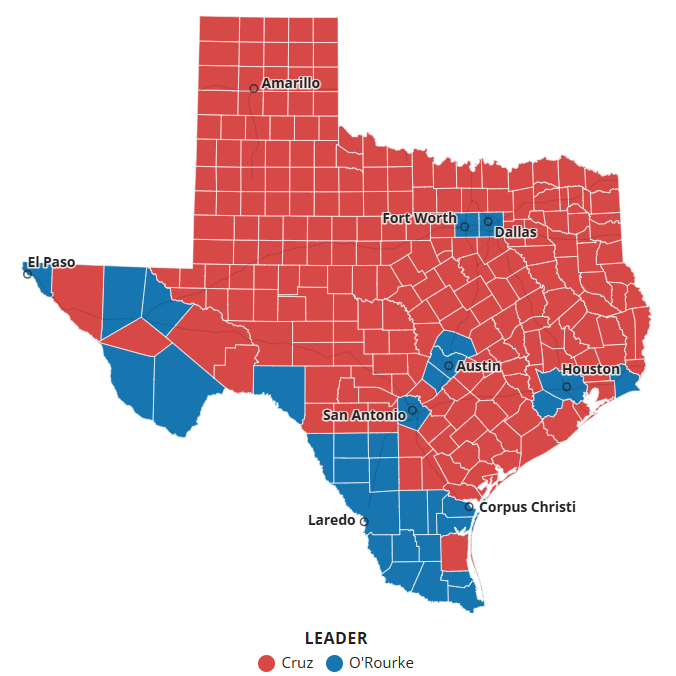
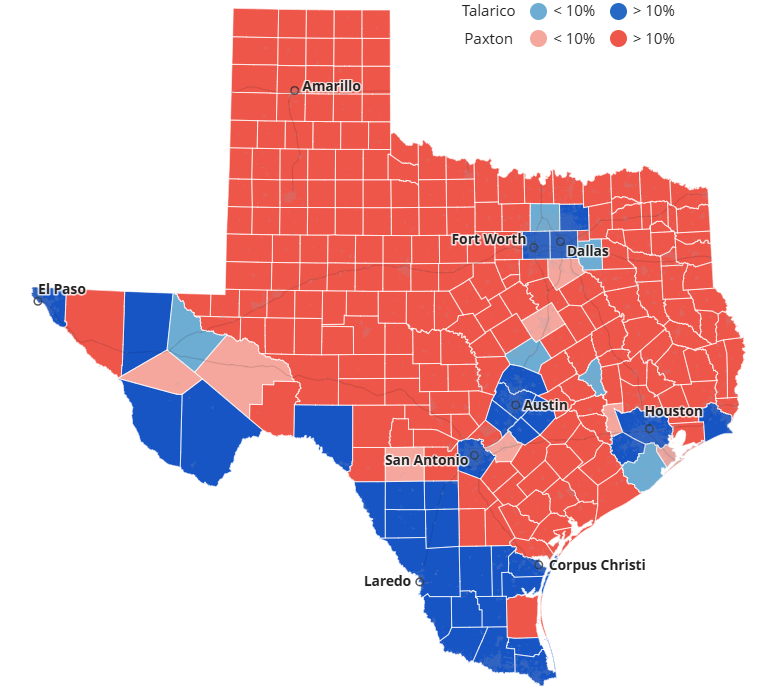
The map on the left is from the 2018 matchup between Beto O’Rourke and Ted Cruz. The one on the right is from the matchup between James Talarico and Ken Paxton. To start, Cruz beat O’Rourke by 2.6%—not a strong margin, but a victory. In 2026, the most significant changes were in North Texas, starting with Tarrant County. In 2018, O’Rourke barely beat Cruz by 0.6% in the county; in 2026, Talarico beat Paxton by 19.3%. Then there were the two suburban counties north of the Metroplex: Collin and Denton Counties. In 2018, both counties went for Cruz by a 7-8% margin. In 2026, that margin flipped for Talarico.
Then there were the pickups of the four Bs: Bastrop, Bell, Brazos, and Brazoria Counties. In McLennan County, the margin dropped a full 10 points from 2018 to 2026. The other significant change was the Rio Grande Valley turning back to blue after the 2024 presidential race.
Looking at the statewide races, we need to see if the down-ballot races benefited from the race at the top of the ticket. That would occur through a tendency toward straight-ticket voting. Even though Texas eliminated that option in 2020, voters still apply the practice on their own, which would create a sweep.
Let’s start by looking at the race at the top: the US Senate race. That race showed the biggest potential for voter crossover, with Talarico winning by a margin of 12.1%. However, when you look down the ballot, the margins had a variance of only about 0.2% overall. That strongly indicates straight-ticket voting. I did look for potential undervoting—a practice where voters only vote on a few select races—and found only about 70,000 to 80,000 possible undervotes.
There are two ways to look at this. The first would be the most obvious: driven by a strong voter turnout—one of the largest for a midterm in recent history—voters rejected anything Republican due to the referendum on Trump. While some voters do look closely at the candidates and their positions, the majority just walk into the booth and vote their feelings. If the feeling is anti-Trump, that translates to voting against anyone with an ‘R’ next to their name.
The second factor is candidate quality. In the period following Trump’s election in 2024, there has been a loyalty push within the Republican Party that starts before the primaries, transfers to the primary elections where MAGA loyalty is tested, and results in candidates who align very closely with Trump. Those included Paxton, Dan Patrick, Mayes Middleton, Don Huffines, Bo French (a candidate who had other problems), and Dawn Buckingham. Nate Sheets had other issues, particularly stemming from his alignment with data center interests.
So, either explanation could apply, but in the end, Democrats and supportive Independents turned out to sweep Texas blue and send a Democratic senator to the US Senate, adding to a Democratic majority that could climb to 56.