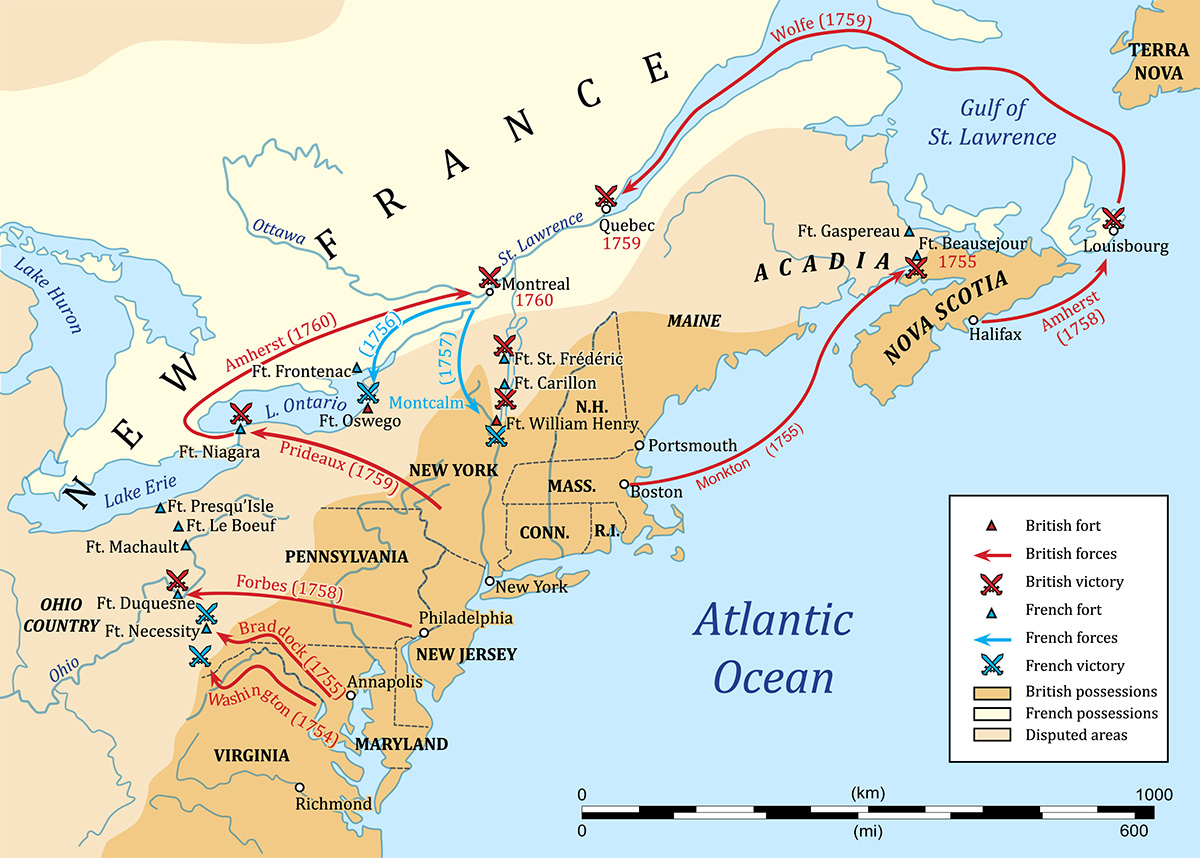

In continuing with my quest to understand how our nation was born, my journeys kept coming back to another conflict that seemed to be the catalyst for the complaints of the colonists. That war was the Seven Years War, a conflict between Great Britain over control of trade in not only North America, but with India and other parts of Europe. In the end, Great Britain was the ultimate victor in the war which establish the dominance of British Empire. But that war came at a great cost for the Crown, saddling Great Britain with an enormous debt that Parliament had to deal with. Hence came the taxes and lack of representation that spurred the discontent of the colonists.
The Seven Years War was about the desire of Great Britain to expand its territories beyond the original colonies in a westward expansion. That expansion would overlap with French territories established for the lucrative fur trading routes from Canada to Louisiana. Great Britain was also a major supporter of Prussia which sought to retain control of Silesia, taken in a prior conflict from Austria. In India, the war was primarily a private one, but one that would determine the control of the tea industry in India.
Great Britain was victor in all three conflicts, winning the Seven Year War, aiding Prussia to defeat Austria, and helping the British East India Company become the monopoly in tea trade in India. But all this came at a great cost. Before the Seven Years War, wartime spending in Great Britain was about ~£7 Million. After the war, it was ~£20 Million. But the big spend was in support of the proxy wars in Europe and India. Before the war, the national debt was ~£74 Million. After the war, it had ballooned to ~£133 Million with interest payments on the debt amounting to half the government’s tax revenues.
Parliament had a major problem after these conquests and needed a way to pay for the costs and started with its homeland citizens. Already heavily taxed, the public reached a breaking point after the imposition of the Window tax based on the number of windows a house had (people started bricking up their windows to avoid the tax), the Cider tax, and numerous other taxes on soap, candles, paper, and beer. You can imagine how unpopular that last tax was.
Still faced with the problem of the debt, Great Britain looked across the ocean to the colonies who were developing into a strong economic force. The way Parliament saw it, the colonies were reaping all the benefit of protection by Great Britain, but paying very little, if any for that protection. The way the colonists saw it, they were developing into their own economic and political world and wanted more say in their affairs.
When Great Britain started imposing the various taxes through the Sugar Act, the Stamp Act, and the Townshend Acts, colonial America started to push back. Only one of those acts the Stamp Act, was actually repealed after widespread boycotts. However, the animosity with the mother country continued to grow.
Following the Seven Year War, King George III was wary of increased conflict with the Indian nations occupying the territory acquired from the war. As such, he issued the Proclamation of 1763 which forbade colonists from expanding beyond an imaginary line in the Appalachian Mountains. This outraged colonists who had fought alongside British troops to win the war. Expansion seemed like a just reward for their efforts.
Then came the Quartering Act which forced the colonies to provide for troops sent to enforce the various taxes. The region most impacted by this act was New England, specifically Boston, which was the trade center of the colonies. The unrest led to the Boston Massacre and eventually the Boston Tea Party. This led to further encroachment on the colonies with the Coercive Acts which closed the port of Boston, abolished the Massachusetts charter, and replaced the government with the military governor, General Thomas Gage.
Colonials throughout the East Coast resented the taxes imposed on them without any representation in Parliament. Their only representative was Benjamin Franklin who lobbied relentlessly with Parliament, but with little effect. The arrogance of Parliament towards the colonies set the stage for even more resentment across the ocean.
Our support from France actually came as a result of the Seven Years War also. King Louis XVI and his foreign minister, the Comte de Vergennes used the conflict between the colonies and Great Britain as a way to fight a proxy war against Great Britain. By providing financial support and sending the French and Spanish navy against Great Britain, it weakened the Empire and reduce its dominance over Europe. Interestingly, that financial support of the colonies would eventually lead to France’s own revolution.
Parliament could have averted some of the conflict if it had extended representation to the colonies, but most likely for a limited time. America had taken root and was growing at an exponential pace, far beyond what Great Britain could achieve. Trying to resolve the conflict by allowing representation and reducing taxes would not satisfy a continent who was starting to thirst for more independence from Great Britain, fueled by the enlightened thinking of philosophers like John Locke.
It’s interesting to look back at our nation’s origins and draw comparison to today. For a nation who was born out of a lack of representation over their own affairs, we have several territories and districts where US citizens have no representation due to constraints by our Constitution. The only way to afford them true representation is to grant them statehood or amend the Constitution, neither of which seem to have any chances. The difference is that those territories do not have the economic clout our original colonies had.